

How To Clean Fire Extinguisher Residue From Grill
No one today would argue the benefits of portable fire extinguishers. According to the latest data, portable burn extinguishers are extremely effective in decision-making small fires. But some of them do leave a mess to clean up, which in some cases can crusade additional damage if not done quickly. This post volition provide some guidelines for cleaning upward fire extinguisher residue and address some of the common prophylactic concerns associated with the chore. While burn down extinguishers may look a lot alike, they can, in fact, exist very dissimilar. Fire extinguishers contain dissimilar chemicals based on the type of fires they are designed to extinguish. Different extinguishing agents tin require different cleanup methods and unique safety precautions. So, you need to know what type of balance y'all're working with. Common extinguishing agents include dry chemicals, wet chemicals, and clean agents. All fire extinguishers are required to be labeled with either a sticker and/or a tag that identifies the type of fire extinguisher it is and the blazon of extinguishing agent it contains. Fire extinguishing residues are mostly non-toxic, particularly in the amounts you lot might expect when cleaning up afterward the use of a portable fire extinguisher. There are a few general precautions you lot should accept regardless of the blazon of burn extinguisher used, as some tin can irritate the skin. Always avert direct contact with any residue past wearing latex or rubber gloves to protect the hands and wear that covers the arms and legs. Cleaning upwards burn extinguisher rest typically does not require expensive personal protective equipment (PPE). Yet, the chemicals in some fire extinguishers tin can also cause pregnant irritation to mucous membranes in the nose and mouth if inhaled and can irritate the eyes. For these types of clean-ups, information technology is of import to habiliment a dust mask and safety goggles. Grit masks with a NIOSH rating of N95 or N100 will filter out 95-100 per centum of the tiny particles found in burn down extinguishers. Before cleaning begins, you lot should always consult the cloth information safety sheets (MSDS), now called safety data sheets (SDS). Both provide all-encompassing and detailed information regarding the chemicals in the remainder y'all will be cleaning up, including whatever safety risks and appropriate types of first help. For most burn down extinguisher residues, bones first aid includes: Beginning aid information is provided here to just to underscore the fact that burn down extinguisher chemicals are generally quite safe. Nonetheless, it is still important to ever accept the time to consult the MSDS/SDS before clean-up begins to ensure that you know all the risks involved likewise as the proper way to dispose of the chemic residue collected. Ideally, at that place will be a hard re-create of the applicable MSDS/SDS onsite. However, if non, you can find MSDS/SDS for the substances contained in a burn extinguisher online by searching the manufacturer'south website using the model number on the fire extinguisher's label. You can also use this searchable database. Dry chemic fire extinguishers piece of work with a pressurized spray of a dry chemical that will coating a fire and extinguish it. The most common agents used in dry out chemical fire extinguishers are monoammonium phosphate and sodium or potassium bicarbonate. Time is of the essence when this type of extinguisher is used considering these powders can be corrosive to metals and can lead to farther harm if not cleaned up chop-chop. Any electrical contacts with residue on them should be cleaned with an electric contact cleaner, which is typically a compressed air canister containing a cleaning amanuensis that evaporates quickly, such as isopropyl alcohol. Information technology is ever a skillful idea, if possible to first shut down the ventilation system in the area to be cleaned to avoid resuspending the powdery residue. It may be tempting to vacuum it upwards. Just before you do, you need to know specifically what blazon of dry chemical agent was used. Monoammonium phosphate fire extinguishers are used to put out Grade ABC fires. This blazon of residue must be cleaned by hand considering it can irritate the skin and optics if resuspended in the air with a vacuum cleaner. If this type of extinguisher was used, you lot can remove residuum from the flooring by wet-sweeping or sweeping with a dust suppressant. Monoammonium phosphate residuum on surfaces should be wiped away with a make clean, dry cloth or brush. According to a 2022 study, soot erasers were also found to be effective for cleaning dry chemical residue on some types of materials. Soot erasers are sponges made of natural condom that can be used to lift away dust, clay, and soot from dry surfaces without getting information technology wet. For surfaces that can be safely wet-washed, a cleaning paste fabricated with equal parts baking soda and hot water can be used. One time practical, the paste should exist allowed to sit on the surface for a few minutes before wiping it away with a clammy cloth. Residue that has hardened or adhered to surfaces can be cleaned with a i:one solution of isopropyl booze and warm water, which will help to break down the silicone used in this type of extinguishing agent. Sodium bicarbonate (blistering soda) burn extinguishers and potassium bicarbonate extinguishers (also known as PKP or "Purple-Chiliad" based on its violet color) are used to put out Course B and some Class C fires. Sodium and potassium bicarbonate residues are not as caustic as monoammonium phosphate residue. Given this, they can be safely removed with a vacuum equipped with the high-efficiency particulate air (HEPA) filter. Bicarbonate-based residues on surfaces can be cleaned in the same manner as monoammonium phosphate with a clean, dry out cloth or brush. For surfaces that tin exist safely wet-washed, an effective cleaning solution for these types of balance can be made by adding approximately iii ounces (six tablespoons) of vinegar to a gallon of hot h2o.[2] Another type of dry chemical fire extinguisher is the Form D dry powder extinguisher, which is used specifically for combustible metallic fires that can occur in industrial, manufacturing, or laboratory settings where there may be concentrations of metal shavings and/or dust that could ignite. The extinguishing agent used in Form D dry powder fire extinguishers will vary based on the specific types of metals constitute in the setting they are used to protect but will normally comprise ane of the post-obit: ● Sodium chloride ● Sodium carbonate ● Copper ● Graphite Some of these residues will clean easily, while others may require the assistance of professionals who are equipped to address the specific requirements of each. Graphite-based powders, for example, are sensitive to static charge and can become combustible if airborne making it dangerous to make clean with a vacuum. Given the different types of agents used in Class D fire extinguishers, it is important to first consult the MSDS/SDS before attempting a clean-up. Course K wet chemic fire extinguishers are used in commercial kitchens to fight cooking fires. These extinguishers use a moisture mixture of element of group i chemicals such equally potassium carbonate, potassium acetate, or potassium citrate that turns into a foam, which blankets the fire depriving information technology of oxygen. Because this blazon of extinguisher is used primarily in commercial kitchens and around cooking appliances, one of the near important steps is to plow off all power to any equipment prior to cleaning it. Make certain everything is completely dry before turning any ability back on for whatsoever appliance. Residue from Form K extinguishers usually clean upwards well with hot water and lather. Do not spray the foam with water as that will but create more foam, making a bigger mess. The all-time approach hither is to vacuum, pump, or use absorbent materials to collect the foam. Whatsoever residue vacuumed with a wet vac should be bagged for proper disposal. If absorbent materials are used, they should be bagged for disposal too. Once the bulk of the foam is removed, yous tin can utilise soap and water to clean up any remaining residual. It is essential to sanitize the entire area after removing burn down extinguisher residual. All dishes, cookware, and utensils exposed should be washed, and any food that has come in contact with fire extinguisher residue should be discarded. Any cloth with residue on it can be washed in a clothes washer with regular laundry detergent. As with all fire extinguishing agents, it is very of import to consult the MSDS or SDS to decide if at that place are any known adverse wellness effects with the chemicals in the remainder. Some cream agents can cause damage to the nervous organisation or vital organs, even with limited exposure. If working with an amanuensis that carries this risk, you will demand to use an air-purifying respirator. Regardless of the type of wet amanuensis you are cleaning, the area should ever exist well-ventilated equally a precaution against inhalation of mist or fumes while working. Depending on the blazon of fire extinguisher used, it may appear that there is nada much to clean. If this is the case, the fire extinguisher used may accept been a clean agent fire extinguisher. Clean agents are electrically non-conductive, non-volatile, and get out no residue, which makes them ideal for use in areas with sensitive electronic equipment or other materials that might exist damaged by water or wet chemicals. There are ii primary types of make clean agents used in portable fire extinguishers today, those that contain carbon dioxide (CO2), and those that contain Halotron, an culling to the older Halon-based extinguishers. While Halon-based burn down extinguishers are however in apply today, they are not every bit common as they once were due to the 1994 ban on Halon production in the U.S. in 1994 over environmental concerns. While most of the gas for clean agent fire extinguishers dissipates into the temper, it is nonetheless a adept idea to clean any areas in which they were used to remove any particulates left behind by the flames themselves and to neutralize any smoky odors. This can be done just by wiping down the affected area with a diluted degreaser. Cleaning upwardly later using a portable fire extinguisher can often be accomplished chop-chop and with surprisingly little expense. However, the chore should not be considered complete until your fire extinguishers are placed back into service and set up for the adjacent time you need them. The National Fire Protection Association (NFPA) x Standard for Portable Burn down Extinguishers requires that burn extinguishers to be recharged afterwards each employ, even if used only partially. If you've recently used one or more than of your fire extinguishers or have concerns regarding their condition, contact Koorsen today. Our team of experts is ready to help with the highest quality products, training, and service to meet all of your fire extinguisher needs. 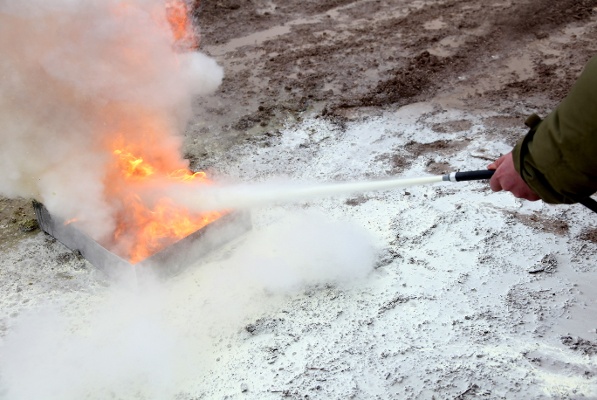

KNOW THE Type OF Residual YOU'RE WORKING WITH
SAFETY CONCERNS
CLEANING UP DRY Chemical FIRE EXTINGUISHER RESIDUE
Monoammonium Phosphate Residual
Sodium and Potassium Bicarbonate Residues
Class D Dry Pulverisation Fire Extinguisher Residue
CLEANING UP WET Chemical RESIDUES
Make clean Agent Burn EXTINGUISHERS Require Lilliputian Make clean-UP
PLACING YOUR Fire EXTINGUISHER Dorsum INTO SERVICE
Topics: Fire Protection, Burn Extinguisher

Source: https://blog.koorsen.com/how-to-clean-up-fire-extinguisher-residue
Posted by: brookswheines.blogspot.com
0 Response to "How To Clean Fire Extinguisher Residue From Grill"
Post a Comment